
At the core of engineering lies problem-solving and innovation. Yet an extraordinary amount of valuable work time is spent not on building, but on searching.
Research shows that knowledge workers, including engineers, can spend more than two hours each day simply trying to locate the right document, data point, or contextual information to perform their jobs.
This inefficiency compounds rapidly. Over the course of a week, it adds up to almost an entire day lost to searching instead of building. For engineering-driven organizations, this means wasted resources, delayed timelines, and missed opportunities for innovation.
Siloed Data: The Root of the Risk
Every engineering team faces the same obstacle.
You need a critical piece of information, perhaps a test summary, a regulatory rationale, or a verification report, but it is hidden somewhere within your documentation. The issue is not a lack of data; it is that knowledge is scattered across disconnected silos:
- R&D/Engineering manages the Design History File (DHF) and change documentation.
- Quality Assurance maintains validation reports and nonconformance records.
- Regulatory and Safety teams store standards interpretations and compliance decisions.
Each function uses its own systems, structure, and vocabulary. Even basic terms such as “verification,” “validation,” or “qualification” can differ in meaning depending on the team.
Critical information is fragmented across PLM, QMS, SharePoint and external regulatory portals.
This fragmentation does more than slow progress. It creates risk, as engineers and quality teams may unknowingly reference outdated or unapproved information. The absence of a unified interface makes it difficult to find the latest version of truth, leaving organizations vulnerable to costly mistakes and compliance gaps.
Need for Unified Interface
When knowledge is dispersed, engineers work without context and decision-making becomes reactive instead of informed.
Every hour spent searching for data is an hour lost to innovation and mission delivery. It calls for a fundamental shift from treating documentation as static records to transforming it into connected, adaptive, and actionable knowledge.
The Enginius.ai Solution: Unify Documentation and Accelerate Understanding
Enginius.ai Nova AI, the intelligent knowledge assistant, turns documentation chaos into connected clarity. Instead of forcing users to search through multiple systems, Nova AI builds a semantic knowledge graph that spans the Design History File, QA records, and regulatory documentation.
Nova AI goes beyond keyword matching. It understands the technical intent behind each term, linking contextually related concepts across repositories. When a quality manager or engineer asks a question, Nova AI delivers precise, validated insights drawn from the right document, in the right context, every time.
With Nova AI, your teams can:
- Instantly surface prior design and verification decisions from DHFs.
- Seamlessly trace requirements through test evidence and regulatory justifications.
- Align understanding across engineering, QA and compliance functions.
- Eliminate redundant reviews and accelerate audits through immediate traceability.
Nova AI empowers organizations to spend less time searching and more time building.
Key Innovations: Powering Accuracy and Trust
Two foundational technologies give Enginius AI the precision and dependability that regulated industries demand.
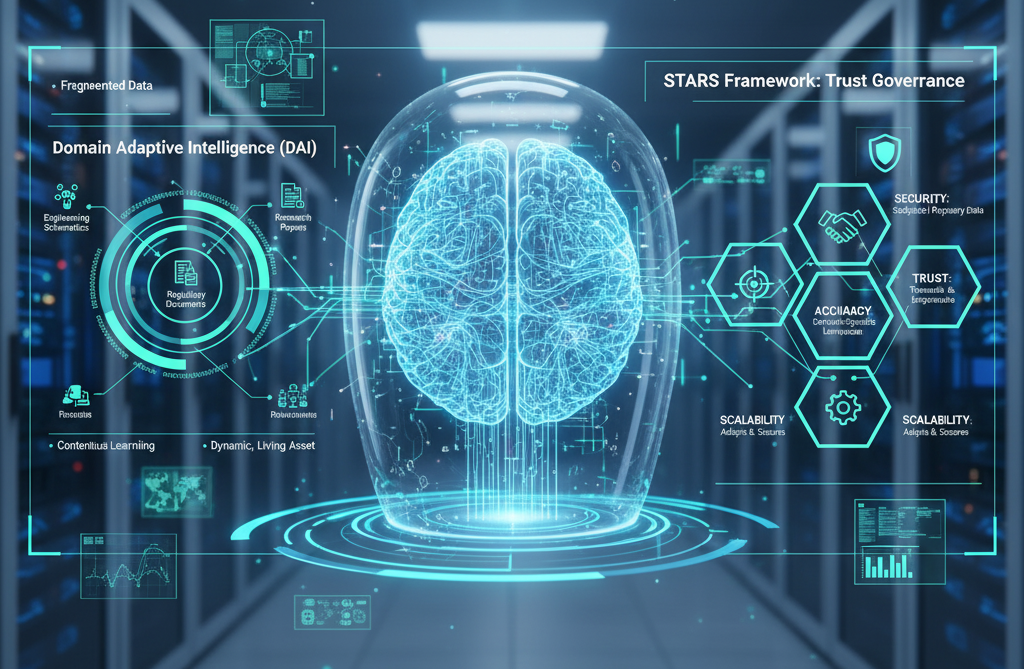
Domain Adaptive Intelligence (DAI): The Engine That Speaks Engineering
Enginius AI’s Domain Adaptive Intelligence (DAI) is uniquely trained on engineering, quality, and regulatory documentation. It captures domain-specific language and structure, bridging the terminology gap between functions.
It understands that “risk control” in QA corresponds to “mitigation strategy” in design, or that a “device master record” aligns directly with “DHF traceability.”
This deep contextual reasoning allows Nova AI to reflect the way engineers and regulators truly communicate, ensuring accuracy and alignment across disciplines.
The STARS Framework: The Governance Backbone
The STARS framework ensures that Nova AI operates with the rigor, explainability, and reliability required by regulated industries. This framework enables true audit readiness and compliance confidence.
- Security: Operates securely behind your company firewall, ensuring full control of sensitive data.
- Trust: Every AI output is traceable to verified source documents, ensuring explainability.
- Accuracy: Preserves technical meaning through domain-specific terminology models.
- Reliability: Produces consistent, repeatable results with minimal bias.
- Scalability: Deploys efficiently on-premise with flexible integration across systems.
Together, DAI and STARS make Nova AI a trusted intelligence layer for regulated engineering environments.
From Documentation Silos to Engineering Clarity
Engineering documentation should empower innovation, not slow it down. By unifying the Design History File, quality records, regulatory evidence and other crucial documents under a single intelligent layer, Enginius AI’s NovaAI turns static information into living, reusable knowledge. When teams can instantly find and trust the exact information they need, they move faster and build with confidence.
Stop searching, start building. Discover how Nova AI accelerates engineering understanding and turns scattered documentation into a strategic advantage.